

Quick Answer

Mobile app campaigns are more forgiving than most affiliate verticals — but only if you separate the install from the event that generates revenue. CPI gets you volume. The post-install action is where the offer actually pays out. Most campaigns fail not because the GEO was wrong, but because the optimization target was.
Why Mobile App Affiliate Programs Look Simple Until You Run the Numbers
The CPI model looks clean from the outside. App installs, pay per install, track with a postback. But what the advertiser is actually buying is retained users who take a specific in-app action — a subscription, a purchase, a registration. The install is just the door. Whether the user walks through it and stays is a separate question entirely.
Most affiliate offers for mobile apps pay on the install because it's easier to track and attribute. That's also why most affiliates running app CPA offers on pure CPI optimization eventually hit a ceiling: the install numbers look fine, the EPC looks acceptable, but the advertiser starts tightening caps or reducing payouts because the downstream retention isn't there. The traffic source was generating installs from the wrong audience segment.
The affiliates who scale consistently on mobile app offers are optimizing one step deeper. They're tracking the post-install event — first session, registration, D1 retention, or in-app purchase - even on CPI-payout offers, because that data tells them which GEO-creative combinations produce users who actually stay. The ones who aren't tracking this are flying on install volume and getting surprised when offer terms change.
On the traffic cost side: according to Business of Apps 2025 CPI benchmark data, Android app installs run $1.50-4.00 globally for gaming categories, and lower for utility and productivity apps. iOS installs in the same categories run $2.00-5.00. Tier-2 markets (Western Europe, Japan, South Korea) typically come in 20-40% below Tier-1 pricing; Tier-3 markets (Southeast Asia, LATAM, India) run 60-85% below. The GEO determines the CPI floor, which determines whether the offer margin exists at all.
The math is not complicated — but it has to be done with real numbers from your actual traffic source and GEO, not industry averages. An Android utility app offer paying $0.80 per install works in Southeast Asia where CPI runs $0.20-0.40. It doesn't work in Germany where Android CPI starts closer to $1.50.
Which Traffic Sources Actually Work for Mobile App Offers?
The platform choice for mobile app campaigns is not arbitrary — it maps directly to the OS/GEO combination you're targeting, and to whether you're optimizing for install volume or post-install quality.
Meta's App Install objective with App Event Optimization (AEO) is the standard entry point for Tier-1 and Western European GEOs. AEO lets you optimize against a specific post-install event rather than raw installs — which directly addresses the retention problem described above. The tradeoff is signal volume: Meta's AEO needs meaningful conversion data before it optimizes reliably, which means you're spending into a learning phase before the campaign stabilizes.
Moloco is a different tool with a different role. It's an ML-driven DSP that runs on Android inventory primarily, and its core strength is ROAS optimization on post-install events. Where Meta works well for narrative-format creatives and Tier-1 social audiences, Moloco runs on in-app placements and is particularly strong for APAC and markets with high Android penetration.
Another mobile DSP Mintegral per the AppsFlyer Performance Index 2025, advanced meaningfully across Android non-gaming categories, which puts it in contention for utility and productivity app campaigns in Southeast Asian and South Asian GEOs.
BIGO and Kwai reach audiences that are underrepresented on Meta in Southeast Asia, the Middle East, and parts of LATAM. The creative format expectations are different — short video, high visual pace, entertainment-adjacent.Running the same creative across BIGO and Meta is a reliable way to waste budget on both.
Xiaomi Ads reaches Android users through Xiaomi's native ad network, with particularly dense coverage in India, Indonesia, and LATAM — markets where Xiaomi holds significant device market share and Google Play campaigns often miss.
Here's how these sources map to mobile app campaign use cases:
| Source | Best OS / GEO | Optimization model | Primary use case | Key constraint |
|---|---|---|---|---|
| Meta (AEO) | iOS + Android / Tier-1, Western Europe | App Event Optimization on post-install events | Subscription apps, fintech, gaming - audiences with high purchase intent | Requires ~50 events/week per ad set to exit learning phase (Meta Help Center) |
| Moloco | Android-heavy / APAC, MENA, LATAM | ML-driven ROAS optimization on in-app events | Gaming, utility apps with measurable post-install actions | Needs sufficient conversion volume to train the model; early spend is signal gathering |
| Mintegral | Android / Southeast Asia, South Asia | CPI and CPA, playable/interactive ad formats | Mobile gaming and non-gaming apps with broad Android user bases | Creative format matters more than on other platforms - playables outperform static |
| BIGO / Kwai | Android / Middle East, Southeast Asia, LATAM | CPM and CPC, video-first formats | Entertainment, social, lifestyle apps; younger demographics | Audience behavior differs from Meta - separate creative strategy required |
| Xiaomi Ads | Android / India, Indonesia, LATAM | CPC and CPM on native placements | Utility apps, productivity, fintech in Xiaomi-heavy markets | Requires local market familiarity; creative localization is not optional |
How Do You Validate a GEO Before Committing Real Budget?
The GEO validation question for mobile apps is slightly different from other verticals because the quality signal you need isn't just landing page CVR — it's post-install behavior. You can have excellent install rates from a GEO and still have a profitable campaign, or terrible install rates and a profitable campaign if the users who do install convert deeply.
In practice, the validation sequence runs like this.
First, establish baseline CPI by GEO on a low-cost traffic source — push traffic or run-of-network inventory — before moving to premium placements. This gives you install volume cheaply enough to see D1 retention and first-session event rates without spending Meta CPMs to gather the initial data. If D1 retention is below 15-20% across multiple GEOs at this stage, the offer or the landing page has a structural problem that more expensive traffic won't fix.
Second, check OS split. The GEO determines which OS your audience is on, and the OS determines which platforms make sense. In most of Southeast Asia and South Asia, Android share exceeds 90%. In Japan, South Korea, the US, and UK, iOS is substantial. Buying Meta App Install campaigns optimized for iOS in Indonesia is buying the wrong audience at a premium.
Third: set up event tracking before you spend anything. The practical minimum is install postback with Sub ID passthrough so you can split results by GEO and creative at the source level. Ideally you're also passing at least one post-install event back to your tracker within 24 hours of install. Without this, GEO validation is just install validation, which tells you half the story.
Networks that support S2S postback as a default — including CIPIAI, which carries mobile app, utility, and software offers across 200+ GEOs — make it possible to run multi-GEO split tests without losing attribution at the offer handoff point. For app campaigns where the conversion event fires server-side hours after the install, S2S isn't a nice-to-have.
GEO tiers worth testing in approximate priority order for mobile app campaigns:
- Tier-3 Android GEOs first (ID, IN, PH, MY, BR) — Low CPI gives you install volume to read post-install behavior cheaply. If the offer's LTV doesn't hold here, it won't hold at 5x the CPI in Tier-1.
- Western Europe Android (DE, PL, FR, IT) — Mid-tier CPIs with strong purchase intent. Good bridge between cheap volume tests and expensive Tier-1 scale.
- US / UK iOS — Highest CPIs and highest LTV ceiling. Use as a scaling destination after retention benchmarks are established in cheaper GEOs, not as the opening test.
- MENA (SA, AE, EG) — Underestimated for utility and productivity apps. Android-heavy, lower CPIs than Western Europe, growing app purchase behavior.
- Japan / South Korea — High CPI but exceptional post-install monetization for gaming and subscription apps. Worth testing only if the offer specifically supports these markets.
What Do Agency Accounts Actually Change for Mobile App Campaigns?
The practical answer is: they change the survival rate of your campaigns during the period when data is accumulating but the algorithm hasn't stabilized.
Mobile app campaigns on Meta go through a defined learning phase. Per Meta's published guidance on App Event Optimization, an ad set needs approximately 50 optimization events per week before delivery stabilizes. On a self-registered account running an app campaign in a competitive GEO, the account often gets flagged, restricted, or billing-blocked before that threshold — especially if the app category triggers a policy review. The campaign takes the account down with it. You lose the event data, the creative performance history, and the pixel signal you spent building up.
Agency accounts extend that window. The account's existing spend history, verified business status, and billing track record give it more runway before automated systems intervene. On campaigns that need 2-3 weeks of data accumulation before AEO exits learning, the difference between a stable agency account and a fresh self-registered one is often the difference between a campaign that optimizes and one that never gets the chance.
Meta's spending pacing mechanics allow the platform to overspend daily budgets by up to 25% on high-demand days — a behavior Meta acknowledges in its documentation. For app campaigns running at scale with multiple ad sets, this variance compounds. Agency account providers like RentAcc enforce deposit-based spend limits, so the actual daily output matches the planned budget.
RentAcc's Platform Coverage Across the Mobile App Stack
Most agency account providers cover Meta. RentAcc covers Meta, Moloco, BIGO —which maps almost exactly to the traffic source table above. The practical implication is that a campaign strategy spanning multiple platforms doesn't require separate agency relationships for each DSP. One provider, one billing infrastructure, one account management layer.
How each platform in RentAcc's portfolio connects to mobile app campaign use cases:
| Platform | Mobile app use case | Why agency access matters |
|---|---|---|
| Meta | AEO campaigns for subscription and fintech apps in Tier-1 and Western Europe. iOS and Android. | Account stability during AEO learning phase. Self-registered accounts rarely survive to 50 events/week in competitive app categories. |
| Moloco | Android in-app DSP for APAC, MENA, and LATAM. ROAS optimization on post-install events. | Moloco's ML warm-up period requires campaign continuity. Agency access ensures the account isn't interrupted before the algorithm stabilizes. |
| BIGO | Short-video format placements in Southeast Asia, Middle East, LATAM. High-frequency, entertainment-adjacent audience. | Lower CPMs than Meta for comparable GEOs. Audience segments with limited Meta footprint - particularly valuable for Android-first utility offers. |
Running a mobile app campaign across Meta for Western European Android installs, Moloco for APAC optimization, and Xiaomi Ads for Indian market coverage means three separate account setups, three billing structures, and three policy frameworks to manage. Consolidating through a single agency account provider compresses that overhead — the infrastructure question becomes simpler so the campaign optimization question can get more attention.
How Do You Scale Once a GEO-Offer Combination Is Confirmed?
Scaling mobile app campaigns runs into the same structural problem as most performance verticals: the tactics that work at $50/day don't work at $500/day because the algorithm's behavior changes when budget increases outpace the event signal it's receiving.
On Meta with AEO, the standard mistake is increasing the budget on a single ad set after it exits the learning phase. The learning phase re-triggers above a certain budget increase threshold — typically 20-30% of the current daily budget in a short window — which resets the optimization and sends performance backward. The correct scaling path is horizontal: launch additional ad sets at a proven budget level rather than pushing one ad set higher.
On Moloco and Mintegral, the scaling dynamic is different. These platforms optimize on ROAS signals across a broader inventory pool, so budget increases don't trigger a manual learning phase reset in the same way. The constraint is usually creative — the DSP will surface your best-performing creative until frequency builds and performance degrades, at which point new creative is the unlock, not more budget.
The platform sequencing that tends to work for affiliates scaling mobile app offers:
Step 1. Validate CPI floor and D1 retention in 3-4 target GEOs using low-cost traffic. Kill GEOs where D1 retention falls below threshold before moving to premium placements.
Step 2. Launch Meta AEO in confirmed GEOs on a single ad set per creative variant. Let each ad set exit the learning phase before drawing conclusions.
Step 3. Replicate winning GEO-creative combinations across additional Meta accounts rather than scaling a single account past its stable budget ceiling.
Step 4. Expand the same confirmed GEOs to Moloco or Mintegral for Android inventory coverage that Meta's placement mix doesn't reach.
Step 5.Add adjacent markets using the creative angles and event optimization targets already validated - not new creative built for the new market from scratch.
Where to Find Mobile App Offers Worth Scaling
Offer diversification at scale means having alternatives on the same tracking infrastructure when an advertiser pauses, tightens caps, or changes payout terms. Building a separate funnel for each offer category is not scalable. Having a network with adjacent categories — mobile apps, utilities, software — that run on the same S2S setup is.
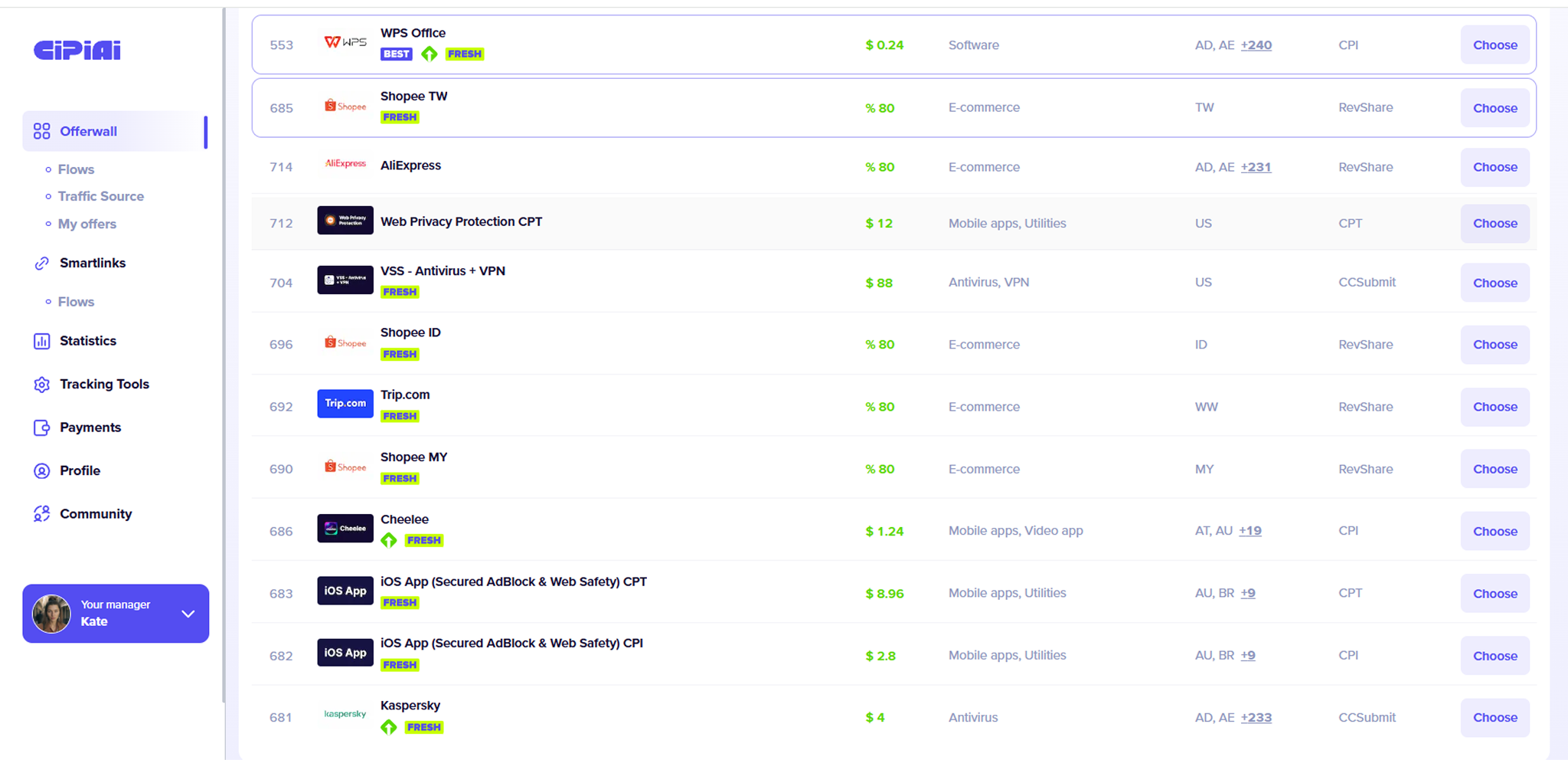
CIPIAI is a CPA network with direct and exclusive offers across mobile apps, utilities, software, and VPN. Automated payouts, minimal hold periods, S2S postback as standard, and offer coverage across 200+ GEOs. Current offer categories relevant to mobile app campaigns:
Mobile utility apps — Android and iOS, CPI and CPA models. Covers productivity, cleaner, security, and optimization app categories with GEO-specific payout tiers.
Software and desktop utility — Complements mobile funnels in markets where desktop conversion is strong alongside mobile (DE, US, UK). Same traffic infrastructure, different conversion flow.
- VPN and security apps — Subscription CPA model across Tier-1 and European GEOs. High per-conversion value; works well as a second offer on traffic that doesn't convert on freemium mobile installs.
- Smartlink — Routes untested or mixed traffic to the best-matching offer automatically. Reduces dead traffic on campaigns spanning multiple GEOs with uneven conversion rates.
Traffback support: unconverted traffic from pop and push sources gets rerouted to alternative offers rather than dropping. Useful for multi-GEO campaigns where some markets convert on the primary offer and others don't.
Register at CIPIAI and apply promo code RENTACC for +15% on your first payout.
Go to RentAcc | Telegram Bot | Latest news
FAQ
What's the minimum budget to test a mobile app offer in a new GEO?
For initial CPI validation on push or run-of-network: based on CIPIAI's experience, a few hundred dollars across 3–4 GEOs is often enough to generate sufficient install volume for an initial directional read on D1 retention. For Meta AEO: plan for at least $300-500 per GEO to accumulate the event data the algorithm needs before drawing conclusions. Below that threshold you're not testing — you're guessing.
Should you run CPI or CPA optimization for mobile app campaigns?
CPI for volume gathering and GEO validation. CPA (post-install event optimization) for scaling once you know which GEO-creative combinations produce retained users. Running CPA optimization too early — before you have enough conversion signal — produces erratic delivery. Running CPI too long — after you've confirmed a GEO works — means you're optimizing for the wrong metric and the offer will start tightening caps on you.
How do you handle iOS vs Android split across platforms?
Let the GEO decide. In most of Southeast Asia, South Asia, and LATAM, Android dominates at 85-90%+ share — Moloco, Mintegral, BIGO, and Xiaomi Ads are the right channels. In Japan, South Korea, Australia, the US, and UK, iOS is substantial and Meta's App Install campaigns or Apple Search Ads make more sense. Forcing iOS campaigns into Android-dominant GEOs wastes budget on a small audience segment and produces misleading performance data.
When does a smartlink outperform direct offer selection?
When your traffic spans GEOs you haven't individually validated, or when you're running mixed-quality traffic where offer-audience match is unpredictable. Smartlinks route to the highest-converting offer for each impression in real time — which outperforms manual offer selection in proportion to how uncertain your traffic composition is. Once you've validated specific GEO-offer combinations, direct offers win on control and often on payout rate.
 Share this post