


IPM is one of the key metrics in mobile affiliate marketing. Improving this metric helps advertisers run ads more efficiently and attract more users to their apps with the same budgets. In this article, we’ll break down what IPM is, how it’s calculated, and why it matters so much. We’ll also talk about how IPM can be increased by optimizing app store pages and ad creatives.
What Is IPM?
This metric shows installs per thousand impressions — short for Installs per Mille. Simply put, it shows how well ads turn impressions into actual installs.
IPM is used to evaluate the effectiveness of ad creatives and targeting strategy. The higher the IPM, the more accurately the ad matches the audience’s interests and the better it motivates users to install the app. IPM growth also has a positive impact on CPM and, as a result, on the overall campaign rating within the ad network. The more installs you get from the same amount of traffic, the more relevant ad networks consider your ads — and the more actively they show them to new users.
If the goal of an ad campaign is user acquisition, it’s important not just to get impressions, but to make sure people actually install the app. IPM does not depend on supply and demand in a specific country, platform, or vertical. This metric reflects only the quality of your ads — how well the creatives are chosen, whether they spark interest among the target audience, and whether they lead to installs.
IPM Formula
You can easily calculate IPM using the following formula:
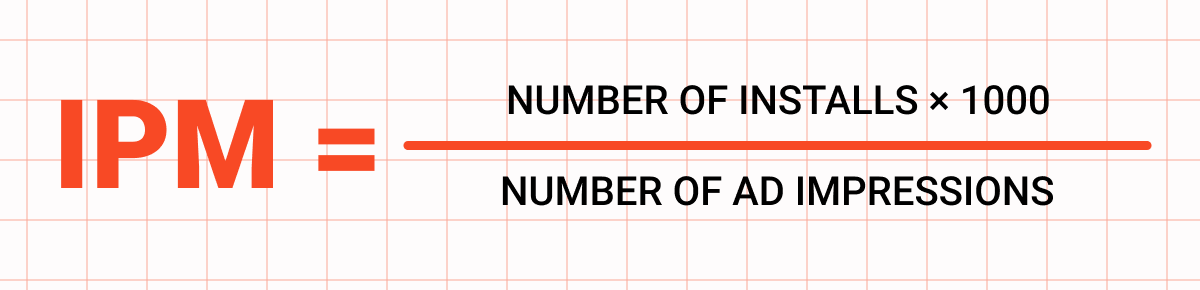
If an ad was shown to 10,000 users and 100 of them installed the app, then IPM = 10.
Calculating per 1,000 impressions is mandatory (that’s the “per mille” part). This standardized format makes it possible to fairly compare the performance of different ad campaigns and creatives, regardless of total traffic volume or the actual number of impressions.
How IPM Is Related to Other KPIs
Back when access to detailed analytics was limited, mobile marketing specialists mainly focused on pre-install metrics — first of all, click-through rate and conversion rate. The main goal was to grab attention and get a click. Today, the approach has changed: for effective user acquisition, it’s important to consider both pre-install metrics and post-install indicators. Only together do they provide a real understanding of traffic quality and campaign performance.
IPM complements classic KPIs well and helps dive deeper into user behavior. The table below clearly shows the difference between the most popular metrics:
| KPI | What it shows |
|---|---|
| CTR | How well ads attract attention |
| CVR / CTI | How well clicks or impressions convert into installs |
| CPI | How much each install costs |
| IPM | How many installs come specifically from ad impressions |
IPM is especially useful when analyzed together with CTR. If a campaign has high CTR and high IPM, it’s a sign of strong targeting and effective creatives. The ads not only attract attention but also motivate users to install. If CTR is high but IPM is low, that’s a signal of problems further down the funnel. Most often, the reasons lie in a weak app store page, mismatched user expectations, or incorrect audience targeting.
IPM Benchmarks
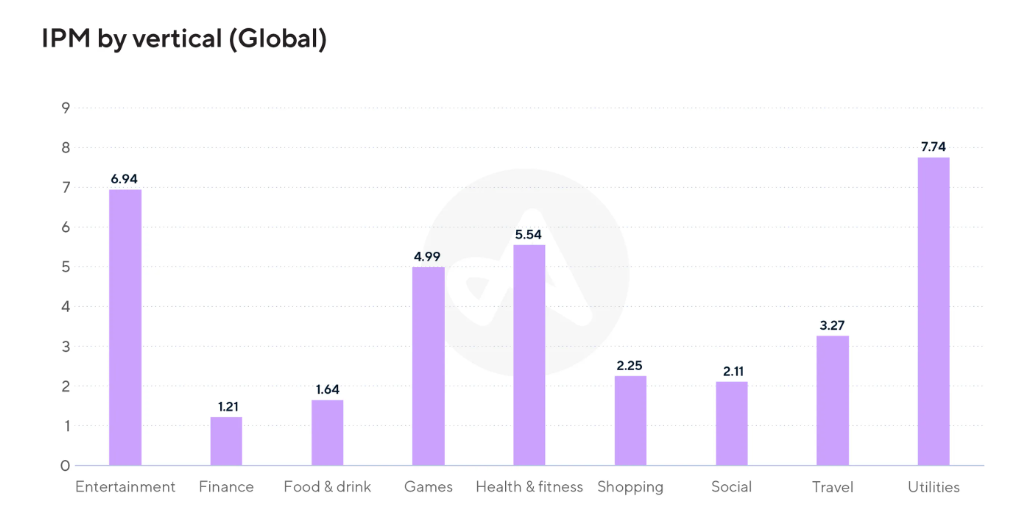
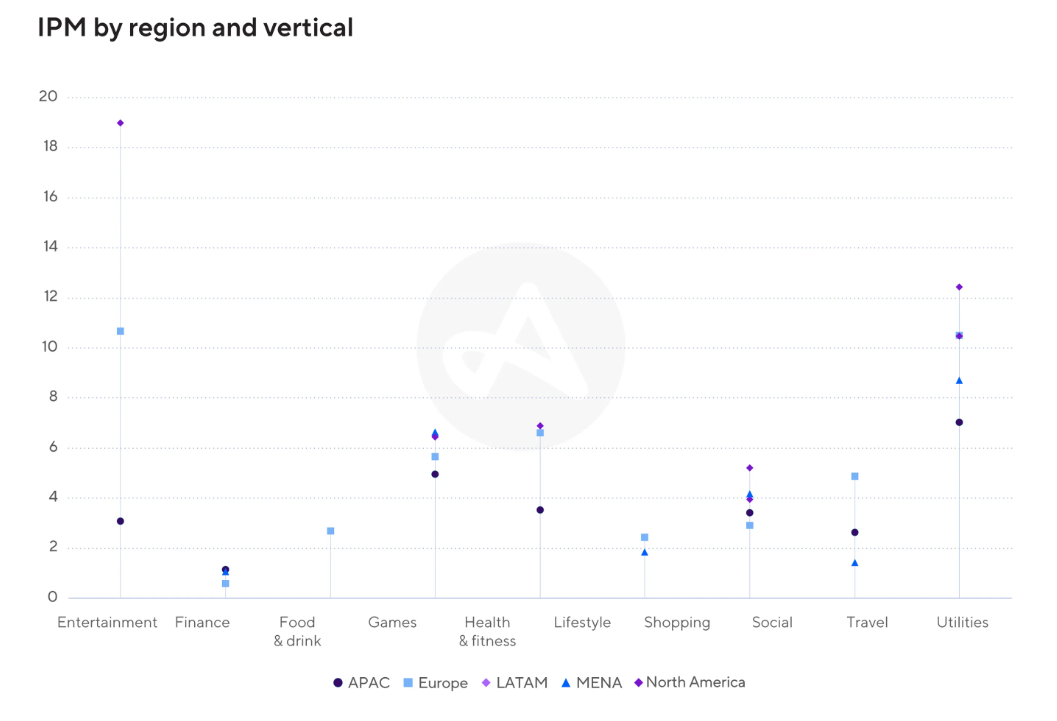
According to 2024 data, on a global level the highest IPM values were shown by utility apps — 7.74. Entertainment apps follow with 6.94. Health & fitness apps demonstrate stable results at 5.54, while mobile games show confident growth and reached an IPM of 4.99.
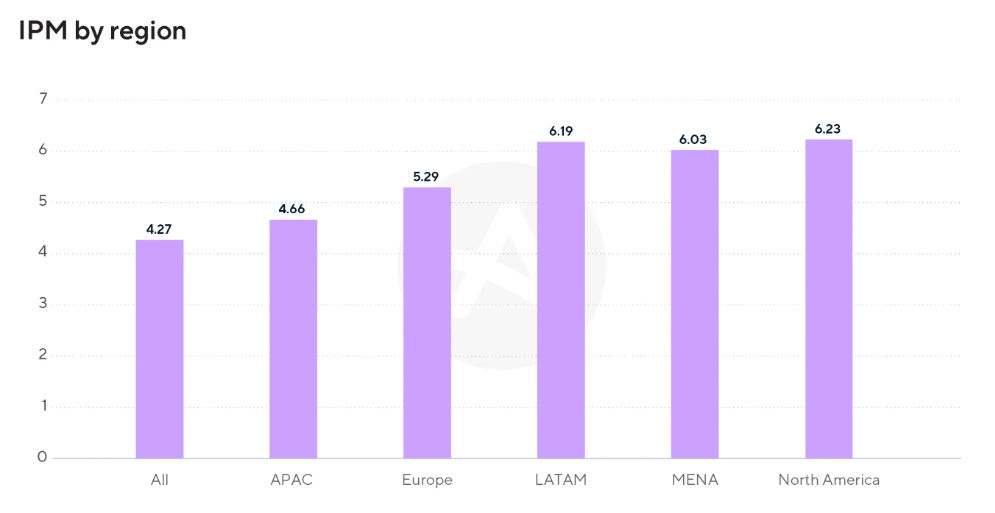
Looking at regions, the global median IPM is 4.27. North America leads with 6.23, which indicates high traffic quality in the region for app promotion.
North America holds leading positions across most verticals. Entertainment apps stand out in particular with an IPM of 18.99, as well as utility apps with 12.42. Latin America also shows strong results, with the most notable growth in utilities — 10.48, and mobile games — 6.49.
In Europe, metrics remain at a solid level: utilities have an IPM of 10.50, while entertainment apps show 10.67. The MENA region demonstrates competitive IPM values as well, especially in utilities and mobile games, with 8.72 and 6.63 respectively. In the Asia-Pacific region, the picture is less uniform. The best results here are shown by utilities — 7.04, and mobile games — 4.97.
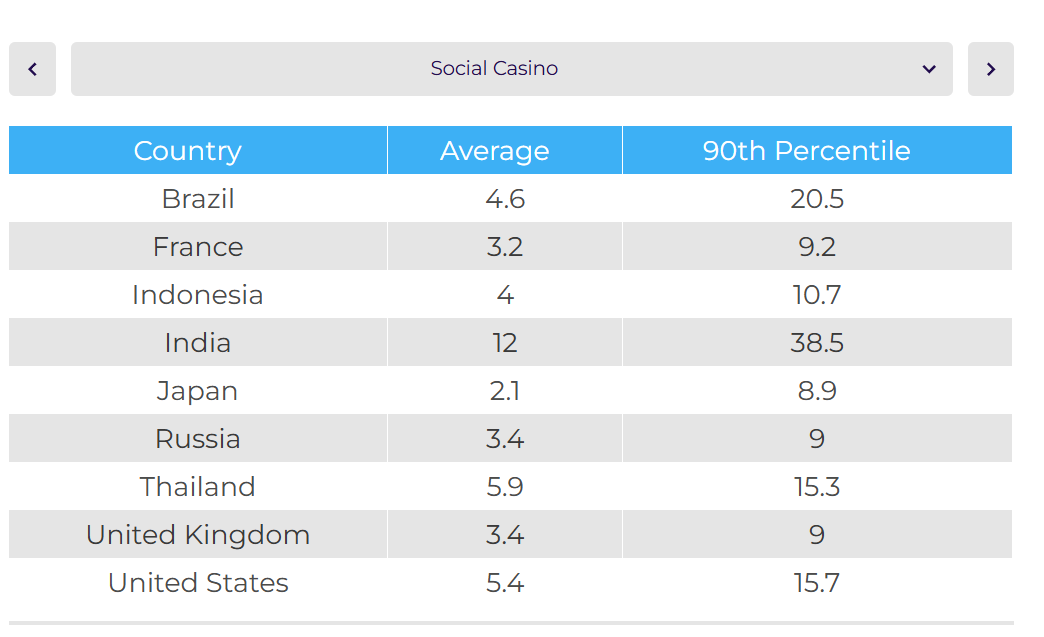
If we look specifically at gaming apps, which are widely used in affiliate marketing, IPM by GEO looks as follows: the highest average values are in India (12), Thailand (5.9), and the USA (5.4), while Japan shows the lowest result at 2.1.
Why Is IPM Important?
IPM is one of the key KPIs in mobile marketing, especially in User Acquisition and performance campaigns focused on installs. Let’s break down the most valuable insights this metric gives advertisers.
1. Campaign performance evaluation
IPM shows not just the number of clicks or impressions, but the real conversion from ad impression to app install. This makes it a more accurate performance indicator than CTR, as it reflects how well the ad motivates users to install the app, not just click on it.
2. Budget optimization
A high IPM indicates that the campaign is running efficiently: you get more installs from the same number of impressions. As a result, CPI goes down and the budget is spent more rationally.
3. Deciding when to improve creatives or targeting
Low IPM is a signal of potential issues. Most often, it points to weak creatives, inaccurate targeting, or an ineffective app store page. This metric helps identify bottlenecks in time and optimize the campaign accordingly.
How to Increase the Number of Installs
There are several effective ways to improve IPM. In most cases, growth is achieved through working with creatives, optimizing the app store page, precise targeting, and traffic quality. Let’s go through each point in more detail.
- Run traffic to broad audiences
The foundation of a high IPM is hitting the right audience. Broad targeting helps you faster find interested users within a large pool. - Optimize ad creatives
Run A/B tests to understand which creatives perform best. Test calls to action, visuals, colors, copy, and headlines. Even small changes can have a noticeable impact on metrics. - Work on app store optimization (ASO)
The app page should reinforce the effect of the ad. Bright screenshots, clear descriptions, and a short, strong USP all increase the likelihood of an install after the impression. If you’re using a rented app, it’s important to create clear and convincing pre-landers to sell the idea before the user reaches the store. - Optimize traffic sources
Monitor traffic quality and reallocate budgets toward sources that show the best IPM. Disable low-performing placements and scale those where ads perform better.
Speaking of traffic sources, if you’re planning to work with Moloco and don’t want to spend time on technical setup and routine tasks, it makes sense to use a specialized automation platform like RentAcc. It allows you to manage ad campaigns from a single interface and focus on testing hypotheses and creating creatives.
The platform RentAcc is tailored specifically for Moloco: it offers fast support, instant notifications about any issues, automatic campaign stops when apps get banned, and flexible auto-rules to control IPM and other metrics. In addition, all spend history is stored in one place, making analytics and scaling much easier.
Conclusion
Although IPM is discussed less often than CTR, this metric is a key indicator of the real attractiveness of ad campaigns. Unlike metrics that evaluate only clicks or impressions, IPM shows how effectively ads lead users to app installs. These insights are extremely valuable for optimizing ad creatives, app store pages, targeting settings, and bid management. Regular work with IPM helps advertisers make smarter decisions and significantly improve overall campaign performance.
 Share this post