

RentAcc is a platform for managing advertising in Moloco and other traffic sources, with ready-to-use infrastructure and full automation. We provide unique tools for safe and efficient work with the source — but that’s only half of the success. It’s just as important to understand how the source actually works.
To break this down using real experience, we spoke with the Seven Group media buying — a team that has been working in iGaming for over 9 years and knows Facebook, Google PPC, In-App traffic and ASO inside out. Their workflow is built around stability, discipline, and deep analytics. This approach makes their perspective especially valuable for anyone looking for honest insights into how Moloco really performs.
Experience with Moloco: who the source is for and what problems it solves
Your team is rightfully considered strong experts in Facebook, Google PPC, and ASO. What motivated you to step away from familiar channels and start testing Moloco?
First of all — diversification. We never rely on a single traffic source or a single advertiser. This makes the business more resilient and less dependent on external factors.
On top of that, we already had an in-app background. A long time ago, one of our first successful iGaming launches was done through Unity. One of the owners hit their first +$30,000 in profit back then. The funnel was targeting CIS GEOs, Unity was delivering well, and all we had to do was scale volume. The only real limitation was caps, but even that was manageable. Traffic quality, however, required extra attention — Unity is a very specific source in that regard.
So we already had in-app experience, which is why we decided to develop this direction in parallel with our other channels.
What was the biggest challenge at the start when working with the source?
The biggest challenge was building a stable infrastructure and identifying the fundamental principles that actually generate profit in Moloco.
From the start, we deliberately refused to blindly copy what’s written in affiliate media. Instead, through testing and analytical work, we developed our own traffic models that differ significantly from standard market approaches. This is what allows us to achieve consistently strong results.
Speaking specifically about Moloco: what share of your total traffic does it account for now, and how do you assess its potential? How does Moloco traffic quality compare to Google and Facebook?
There was a period when Moloco accounted for one of the largest shares in our traffic split. At this point, however, we’ve reallocated priorities and significantly scaled other directions. We always go where the math works best at a given moment.
In terms of quality, Moloco operates like an advanced LLM-based system — results directly depend on how well the algorithm is trained on the “app + creative” combination. The traffic we receive is high-quality and “live,” and in terms of payback, it competes confidently with market leaders like Facebook and Google.
How is your work with accounts and infrastructure currently structured inside the team?
Account management within the team is built on full autopilot. When a new buyer joins, we quickly provide a pool of accounts and integrate them into our automation system.
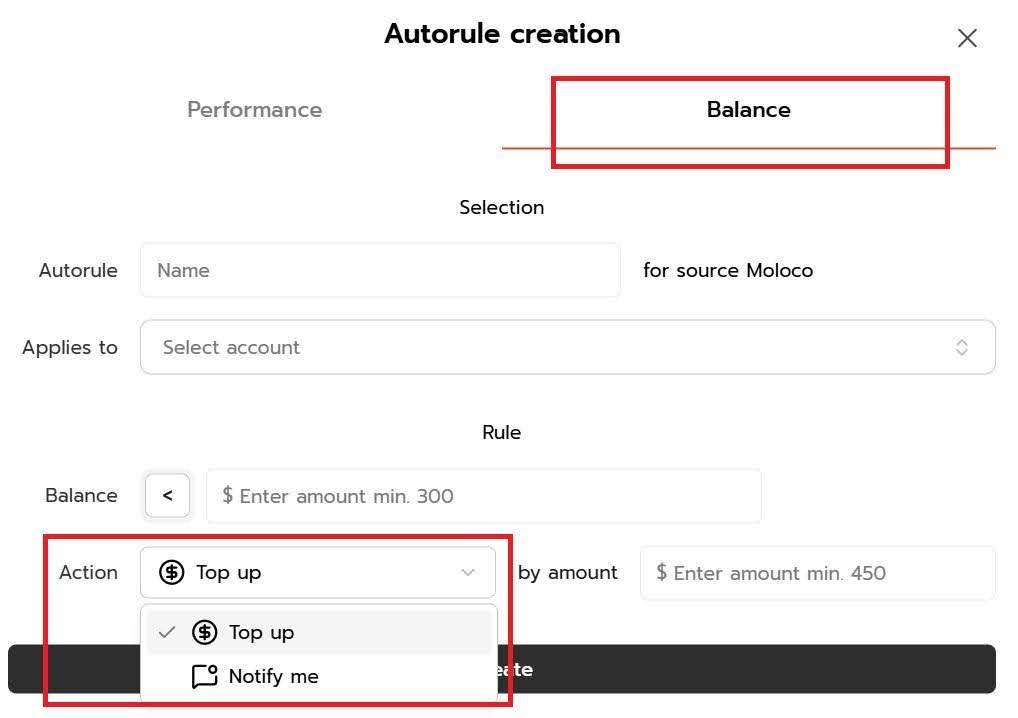
We use RentAcc AutoRules in Balance mode, which ensures uninterrupted top-ups. As soon as the system detects that the balance is running low, a notification is automatically sent to the finance department for payment. This setup allows buyers to avoid technical routine and fully focus on analytics and scaling profitable funnels.
How do you test hypotheses: budget allocation, creatives, and so on? How does this process differ from Facebook or Google?
Whenever we test something at Seven Group, we launch a set of campaigns and evaluate their performance strictly based on metrics. This process requires a systematic approach.
The key difference from Facebook is that in Moloco we launch fewer campaigns but allocate more budget to each one. This allows the algorithm to learn more effectively and gives us more representative results.
Many beginner buyers have questions about creatives in Moloco: how many are needed, how often they should be changed, and how to understand when a creative has burned out. What advice would you give?
The main advice is to shift your focus from individual creatives to the overall approach. Don’t obsess over the number of creatives or how frequently you rotate them. A conceptual approach and focus on the funnel idea itself provide far more scaling opportunities than endlessly cycling through content.
If the strategy is right, it allows for systematic scaling. If you rely on a single successful creative, you’ll hit a ceiling very quickly and won’t be able to build stable traffic volume.
Which creative formats (static, video, HTML, etc.) work best in your opinion?
We don’t limit ourselves to a single format — everything has its place in Moloco, including static and HTML. That said, video remains our top performer in terms of efficiency.
Playable creatives are another working format within Moloco, but they’re not a silver bullet. They can strengthen an overall strategy, but they are not a foundational solution on which all results are built.
From Theory to Practice: How to Launch and Scale Campaigns
What budget is needed to start in Moloco?
It all depends on your goals and strategy. Moloco is definitely not the cheapest entry point, but it’s also not the most expensive compared to other major market players.
The auction realities are as follows:
Tier-1 and Tier-2: in these regions, the Moloco auction is able to efficiently sustain budgets of $1,000–1,200 per day per campaign while maintaining target profitability.
LATAM: Latin American GEOs are potentially capable of “absorbing” significantly higher budgets.
Which GEOs and offers are generally easier to start testing with in Moloco? And what about large volumes and experienced buyers?
When choosing GEOs, we rely on two factors: internal expertise and cost of market entry.
For beginners, it’s optimal to start with regions where the cost per deposit is lower. This allows you to build an initial pool of offers and test more hypotheses with lower overall spend.
How do you scale: number of apps, campaign budgets, or number of campaigns?
We use a combined approach and leverage all available levers: budgets, number of campaigns, and number of apps. At the same time, we always stick to the principle of economic efficiency and prioritize quality over quantity.

In practice, it’s often much more profitable and effective to fully scale one successful app with proven metrics than to launch everything at once in the hope of generating volume.
What do you do if ROI is unsatisfactory?
For us, working with negative or zero ROI is primarily a matter of discipline and staying within predefined performance “corridors.”
Here’s how we act in such cases:
a) If hypotheses don’t prove themselves during testing
We don’t rely on luck. If campaigns show poor results and the economics don’t validate at the testing stage, we simply turn them off. This helps preserve budget for more promising directions.
b) If a campaign was profitable but stopped converting
Here, we take an individual approach and analyze a combination of factors:
- on which day the conversion drop occurred,
- how long the downturn lasts,
- what the campaign’s historical ROI was,
- at what daily budget the issue appears.
This level of analysis helps us understand whether it’s temporary auction volatility or whether the funnel has actually exhausted itself and needs to be replaced.
How much do you spend before turning off non-performing approaches?
There is no strictly fixed amount that we must spend before stopping — every case is individual.
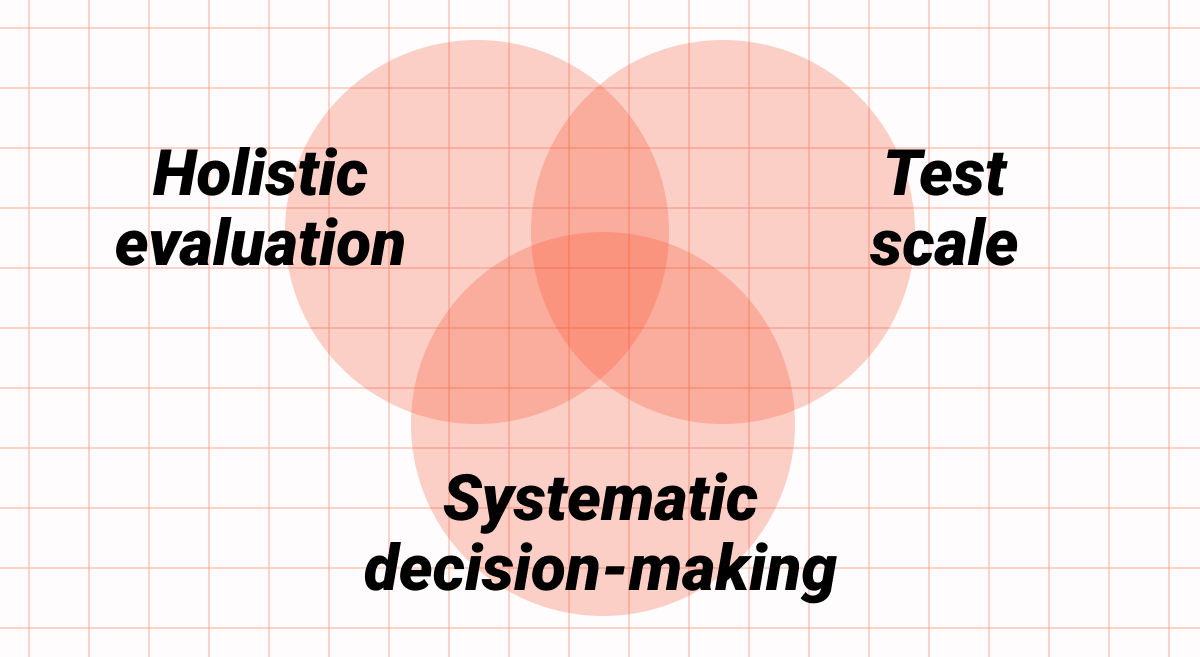
Our analytical approach is based on the following principles:
- Holistic evaluation
We don’t micromanage inside ad sets or try to pull out or restart individual elements within a running algorithm. We evaluate the performance of the entire campaign as a whole. - Test scale
If a specific approach is launched across multiple campaigns and shows no results in any of them, we stop working with it. - Systematic decision-making
We rely on clear decision rules and control points that allow us to stop inefficient traffic in time, without waiting for a random “lucky break.”
If a creative doesn’t work for one app, do you test it on another?
Possibly, yes. Since Moloco operates like an LLM-based system, results always depend on the unique combination of a specific app and a creative.
If we see potential in an approach, we may give it a second chance on another app — the algorithms may train differently and find the target audience where they didn’t before. However, we always correlate such tests with our efficiency “corridors” to avoid spending budget on clearly weak funnels.
Do you disable poorly performing placements (Publisher app / Publisher app category / Exchange)?
We don’t practice manual disabling of individual placements. We allow the algorithms to work with the full dataset without limiting their potential through manual interventions — the system is capable of optimizing delivery toward our target KPIs on its own.
Campaign objective: In-app event or ROAS?
We choose In-app event and work with a CPA model, because ROI is our top priority.
ROAS is more suitable when you work very selectively with advertisers and they share the full range of data that can be passed to the platform for algorithm training.
What’s Next: Affiliate Trends and Seven Group’s Plans
Let’s wrap up by looking a bit ahead and talking about 2026. Which approaches, in your opinion, will be the most effective for Moloco, and why?
The fundamental approaches will remain the same, but content nativeness will change significantly. Motion design is gradually losing efficiency, giving way to native UGC. Those who can successfully mimic organic user-generated content will have a clear advantage.
What tools would you consider essential for teams that want to earn consistently with Moloco?
As trivial as it may sound — reliable ad accounts. Without stable infrastructure and expendables, no set of tools will help you launch properly.

If you’re looking for stable infrastructure to work with Moloco, RentAcc provides ready-to-use agency accounts with built-in automation:
- automatic campaign stop when an app gets banned,
- autorules for performance and balance control,
- real-time spend statistics.
To wrap up, share Seven Group’s plans for 2026. What will the team focus on at a strategic level?
We plan to keep expanding and are actively looking toward growing our partnerships.
- If you’re a direct advertiser and need high-quality traffic, we’re open to discussing cooperation — volumes, approaches, formats, and terms.
- We’re also looking for media buyers. If you know how to run traffic and are ready to work, we’re always interested and willing to pay above market rates.
🔗 Seven Group links:
- Website: https://sevengroup.one/
- Telegram channel: https://t.me/+UO--n2ZdczsyNTc6
- HR bot: https://t.me/ftd_by_ftd_bot
Key Takeaways
Moloco is a traffic source that requires a systematic approach, stable infrastructure, and a data-driven mindset. Seven Group’s experience clearly shows that there is no room here for impulsive decisions or chaotic testing. Only discipline, automation, and deep analytics.
Work with reliable tools. Learn from practitioners.
 Share this post