

Most mobile marketers operate on someone else's infrastructure. You hand over your budget to an ad network, receive a report and have no choice but to trust the numbers inside it. Kayzen works differently: the platform puts the bidder, algorithms, and dashboard in your hands. You have to bid in the auction yourself.
Kayzen launched in 2019 as a self-serve DSP for mobile in-app traffic. CEO Tim Koschella and Chief Product Officer Puneet Gupta describe the platform as one of the first in-house bidders built specifically for mobile. At the time, its closest counterpart in the desktop market was Beeswax.
Kayzen's users include affiliate marketing teams, app developers and e-commerce brands that want to manage user acquisition and retargeting themselves rather than relying on a managed service. Let's take a closer look at how it all works.
How the Platform Works
Kayzen's product is built modularly: the platform consists of a bidder, algorithms, an ad server and a UI. Depending on the subscription plan, teams gain access to different features—basic media buying, reporting, CPI/CPA goals, Inventory Discovery, advanced API, white label solutions and more.
The pricing model is SaaS-based: each plan includes a certain amount of ad spend, with additional charges applied if that limit is exceeded. As a result, teams pay a transparent platform fee for access to the infrastructure and media buying volume instead of hidden markups commonly found in closed ad networks.
If a team only needs bidding logic, it doesn't have to pay for the ad server fnd vice versa. Most clients work through the web interface, while some use the API. This is what distinguishes Kayzen from the two platforms it is most often compared to:
- Liftoff operates as a fully managed service: advertisers receive reporting while the Liftoff team manages the campaigns;
- Moloco occupies a middle ground: self-serve access is available as an option on top of its managed core.
Kayzen, on the other hand, was built around a different philosophy from the very beginning: campaigns are managed by the advertiser, while infrastructure modules can be added as needed.
Why Bring Media Buying In-House
Kayzen is built around three key pillars: transparency, control, and media buying economics. In closed DSPs and managed ad networks, advertisers often see only the final numbers: spend, installs, events, and ROAS. However, it is not always clear how much of the budget was spent on media itself and how much went toward the platform's markup.
In such models, margins can range from 30% to 70%. When using your own bidder, costs become much more transparent: the team pays for access to the software rather than for managed media buying with additional markups. According to Kayzen, in this scenario, platform fees are typically reduced to 7–15%.
The second argument is data. When media buying runs through your own infrastructure, the team gains access not only to standard reporting but also to more detailed analytics: custom reports across 50+ metrics, raw logs, cohort analyses for retention and ROAS. In closed platforms, this level of data is often unavailable or heavily restricted.
If your media buying team manages campaigns across multiple app categories, detailed analytics are useful not only for optimizing bids and creatives. They also help explain to clients where the budget was spent, which traffic sources performed best, and why specific decisions were made.
There is also a technical reason. Mobile in-app auctions operate differently from desktop auctions. Due to waterfall logic and mediation layers, some bids never result in an actual transaction, even when the bidder participates in the auction. That is why Kayzen separately measures clear rate alongside win rate. This distinction is important in mobile advertising but is rarely found in desktop DSPs.
Kayzen also emphasizes that mobile media buying is typically focused not on upper-funnel brand metrics but on down-funnel events such as installs, registrations, purchases, and user re-engagement. As a result, desktop DSPs do not always translate well to mobile in-app advertising, where auction mechanics, campaign goals, and data control requirements are fundamentally different.
How Machine Learning Works in Kayzen
On top of its bidder, Kayzen runs a set of machine learning algorithms designed to automate part of a trader's manual work. These algorithms help optimize bids more accurately, redistribute budgets efficiently, and identify underperforming combinations more quickly.
Bid shading reduces the risk of overpaying in first-price auctions. CPC and CPI optimization models evaluate the likelihood of clicks or installs in real time using more than 40 different signals.
Creative rotation automatically allocates more budget to the best-performing creative combinations while reserving part of the budget for ongoing testing. Auto-blacklisting removes exchange–app combinations from rotation if they fail to meet predefined performance thresholds.
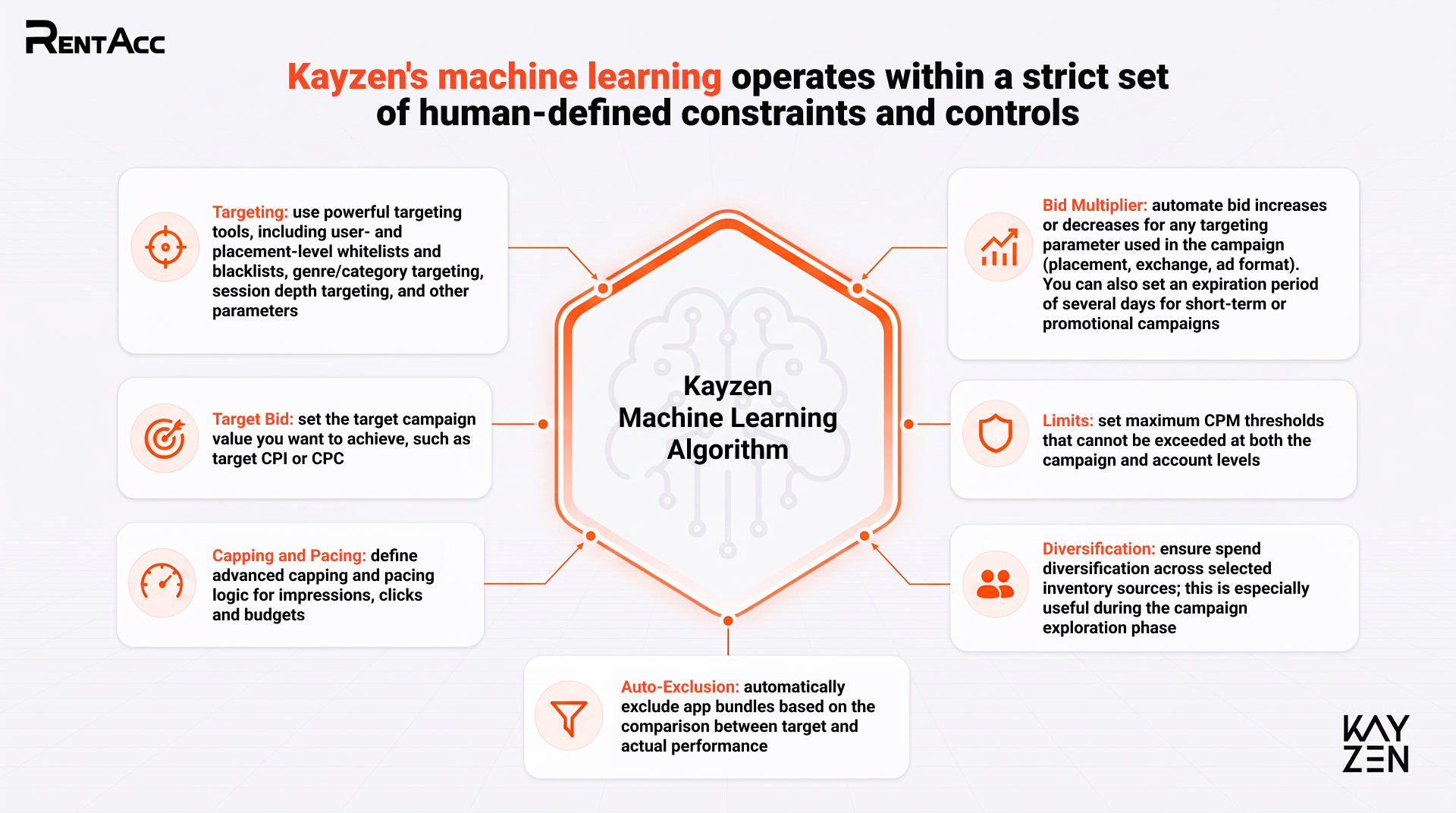
At the same time, the algorithms do not operate as a fully autonomous system.
The advertiser defines the framework by setting target bids, dimension multipliers, pausing and capping rules, CPM ceilings, allowlists, and blocklists. The algorithm does not replace the media buying strategy—it operates within the constraints established by the team.
Kayzen also offers kAI Companion, a built-in assistant that helps advertisers understand changes in campaign delivery and spending. It explains why a campaign may have started spending more or less than expected and suggests which factors should be reviewed next.
Launching a Campaign in Kayzen
What is important to consider in advance
Before getting started with the platform, it's important to understand its capabilities.
What is currently available in Kayzen:
- In-app traffic through programmatic inventory;
- Optimization for CPM, CPC, and CPI;
- Integration with MMPs and postbacks;
- Whitelists and blacklists by traffic sources;
- Real-time campaign and inventory analytics;
- Ad formats: banner, native, video, and playable.
Kayzen operates under a SaaS model and offers several ways to work with the platform:
- Self-service via the interface or API;
- Managed service;
- Hybrid model.
In all cases, your data remains under your control.
Access to a Kayzen advertising account is available through RentAcc. RentAcc's commission depends on your spending volume and decreases as your budget grows. The commission starts at 8% and may be reviewed individually depending on the total ad spend.
➡️ The minimum deposit required to get started is $2,000.
However, this amount is typically not sufficient for полноценного testing. According to Kayzen, its algorithms require approximately 300 positive events (installs or target actions) to complete the learning phase and begin optimizing campaigns consistently.
In addition to providing access to the advertising account, RentAcc offers infrastructure for campaign management, including:
- Spend history;
- Centralized financial management;
- Fast account top-ups;
- Assistance with source setup when needed.
Where to start the launch
Launching a campaign in Kayzen begins not with creatives or bids, but with tracker integration. First, the team connects an MMP such as Adjust or AppsFlyer, creates an app object within Kayzen, and links it to an API key. Click links and postbacks are then configured so the platform can track installs and in-app events.
Next, the campaign is structured using a two-level hierarchy. At the Order level, advertisers define the app, budget, tracking settings, and a suppression list—a list of users who have already installed the app and should not be targeted again. Individual campaigns are then created within the Order, where GEOs, devices, operating systems, and creative formats are configured.
Kayzen supports the main mobile advertising formats, including banners, native ads, video, interactive Video+, and playable creatives. All assets are uploaded through the Asset Manager. For video creatives, using VAST 3.0 is recommended to minimize the risk of technical issues during upload.
After the basic setup is complete, the team selects an optimization model, such as CPA or CPI. At the beginning of a campaign, it is common to allocate a learning budget, as the algorithm needs sufficient data before it can accurately optimize bids and budget allocation. Whitelisting and blacklisting can be used to control traffic sources, while Inventory Explorer helps evaluate publishers before adding them to either allowlists or blocklists.
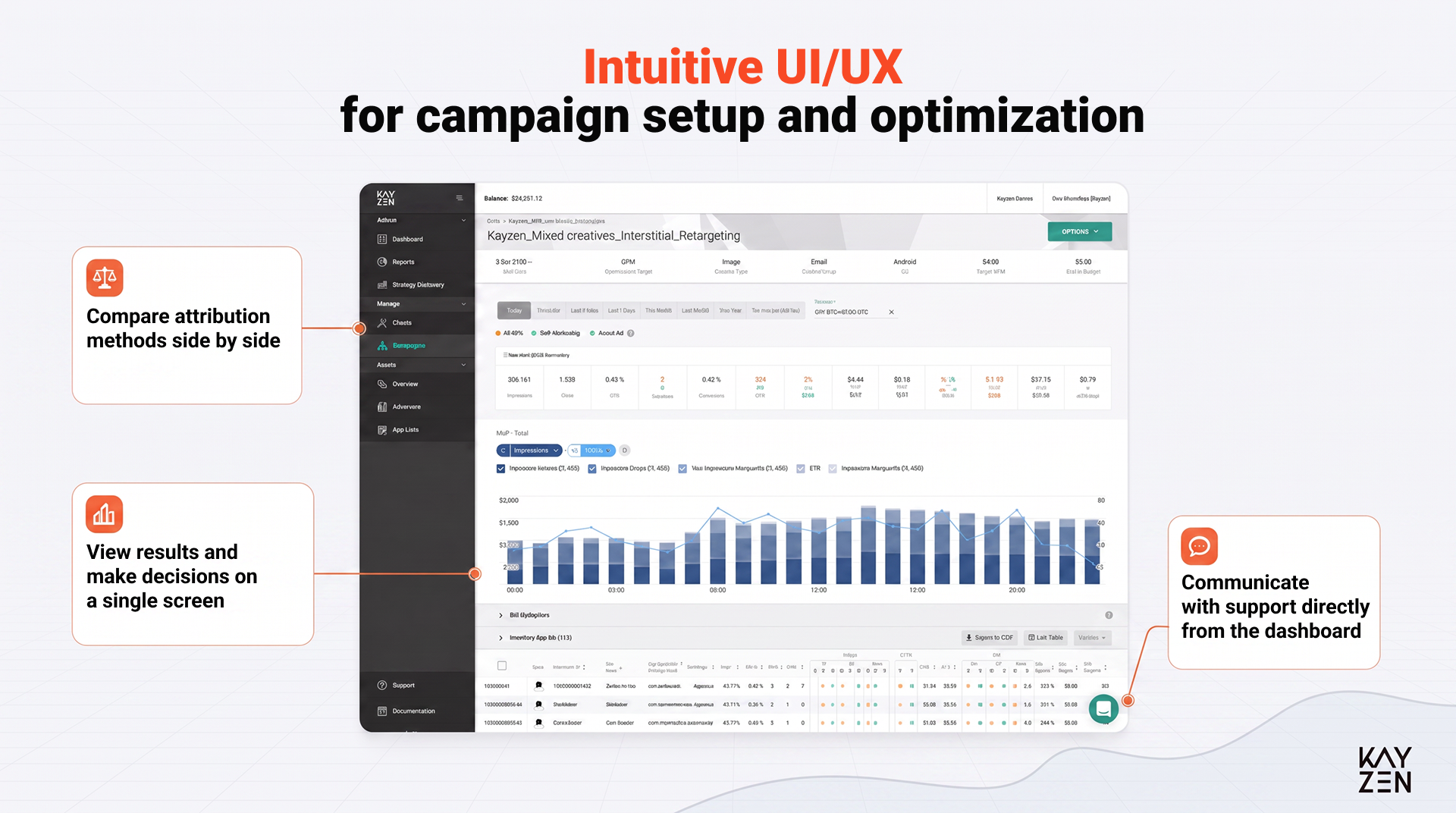
Once the campaign is live, performance can be monitored through the dashboard, which provides real-time data on media costs, CPM, impressions, and conversions. If delivery or spending patterns begin to change, kAI Companion helps identify the cause and suggests which campaign settings should be reviewed.
Reach and Traffic Sources
Kayzen is integrated with major mobile ad exchanges and works with MMPs such as Adjust and AppsFlyer for attribution. Ad delivery is powered by a global CDN network with points of presence across multiple regions. For advertisers, this means access to a large volume of in-app inventory and consistent buying speeds regardless of campaign GEO.
The platform includes an Inventory Discovery module that scans approximately 150 billion auctions daily and identifies new publisher–placement combinations that have not yet been categorized within the system. The discovered inventory is classified using Smart App Categories: Kayzen assigns each app to a category based on its content and audience behavior, allowing advertisers to configure targeting and blacklists without manually labeling every publisher.
Kayzen also supports SKAN campaigns for iOS and takes Apple's limit of 100 campaign IDs per app into account. The platform automatically distributes these IDs across GEOs and creatives to prevent advertisers from hitting the limit prematurely and losing attribution data during a campaign.
What Real Users Say
Kayzen has a rating of 3.5 out of 5 on G2. The reviews accurately reflect the platform's philosophy: users appreciate the level of control and flexibility but note that it requires a more mature approach to media buying.
Among the advantages most frequently mentioned are the intuitive interface and convenient access management. For affiliate marketing teams, this makes it easier to manage multiple clients within a single infrastructure without purchasing separate licenses for each advertising network.
The main criticism from users concerns billing. According to the reviews, billing is CPM-based. Therefore, teams optimizing for CPI goals should separately monitor their actual CPI performance and compare it with data from their MMP.
Public case studies provide a clearer picture of the platform's strengths.
A European brand-performance agency reported accelerated mobile growth metrics after switching to Kayzen. Gaming studio PLAYSTUDIOS recorded a 42% month-over-month increase in in-app purchases after moving its retargeting efforts to its own bidder.
Overall, Kayzen is not a DSP that you can simply "set and forget." It is designed for teams that want deeper control over media buying: greater data visibility, margin transparency, and the ability to independently decide how budgets are allocated across traffic sources.
Who Is Kayzen For?
Kayzen is best suited for teams that already have the people, data, and processes required to manage media buying independently:
- Affiliate marketing teams managing multiple clients or offers on in-app traffic;
- App developers that have moved beyond the early growth stage;
- E-commerce brands with sufficient scale to justify building in-house expertise.
The platform provides more control than managed DSPs, but that control needs to be used effectively. Teams will need a trader, analyst, or at least a specialist who understands bidding strategies, traffic sources, cohorts, CPI/CPA economics, and blacklist management. Without this expertise, Kayzen may feel too manual.
Teams without an in-house trader or analyst should expect to be more involved in the platform's setup. Kayzen provides the infrastructure for media buying—it delivers data, offers flexible configuration options, and automates part of the process. However, the media buying strategy and campaign logic remain the advertiser's responsibility.
Teams running campaigns simultaneously across Facebook, Moloco, and mobile DSPs such as Kayzen often face challenges that go beyond choosing the right platform. Managing advertising accounts, budgets, payments, and access permissions becomes increasingly difficult, especially at scale, where account top-ups and bans consume valuable time.
➡️ This is the operational side that RentAcc.Agency is designed to handle.
Kayzen provides the DSP infrastructure itself: access to in-app inventory, bidding capabilities, optimization tools, analytics, and campaign management. RentAcc's CRM platform, in turn, helps manage advertising accounts, access permissions, budgets, top-ups, account statuses, and spend control. It creates a convenient environment for teams buying traffic at scale across iGaming, gambling, app installs, and other performance marketing verticals.
RentAcc provides access to advertising accounts, simplifies financial management, assists with top-ups and account support, allowing media buyers to spend less time on routine tasks and focus on testing and scaling campaigns.
Want to test Kayzen? Submit your request through RentAcc.Agency—we'll provide access and help you get started with your first campaign.
 Share this post